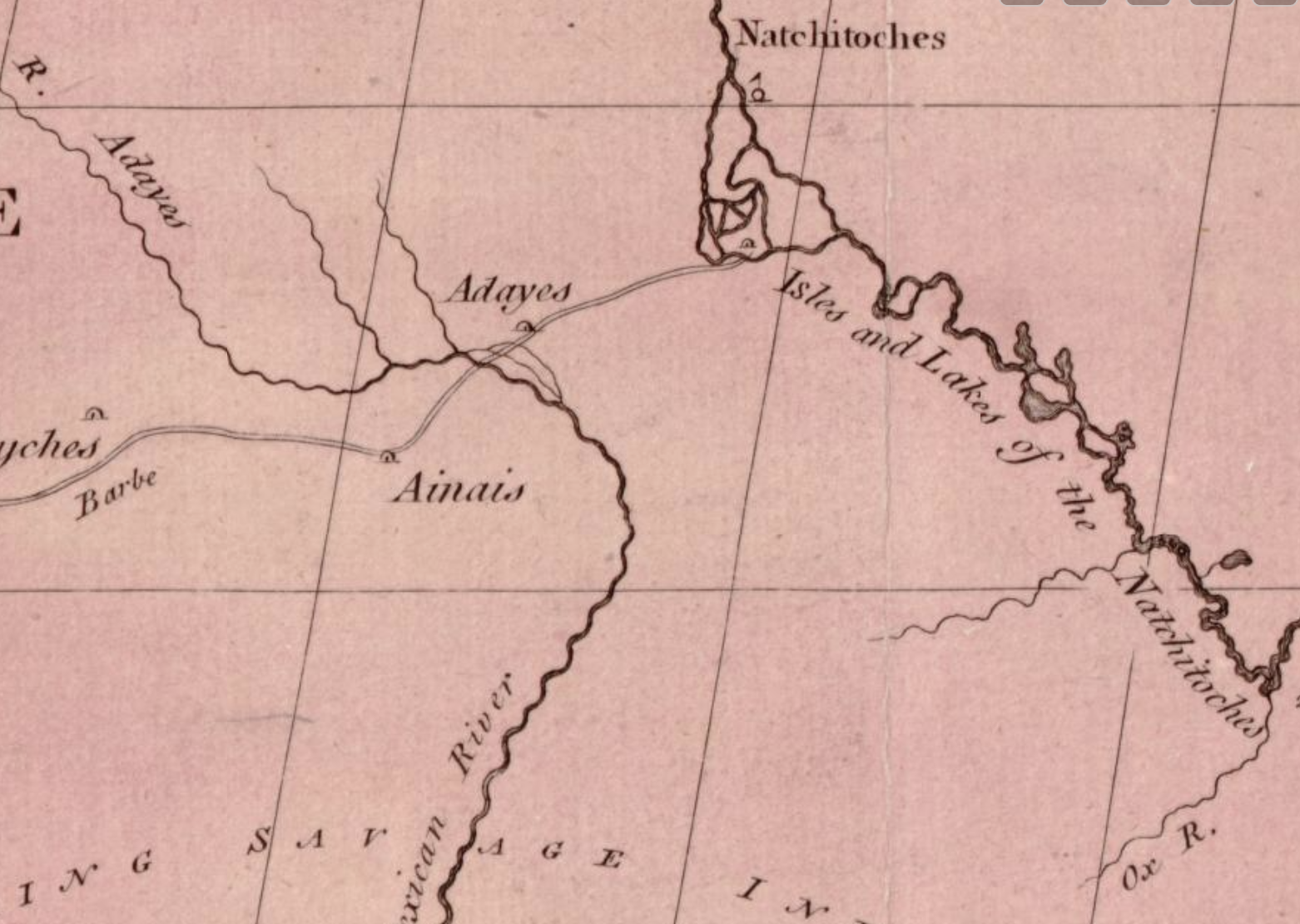
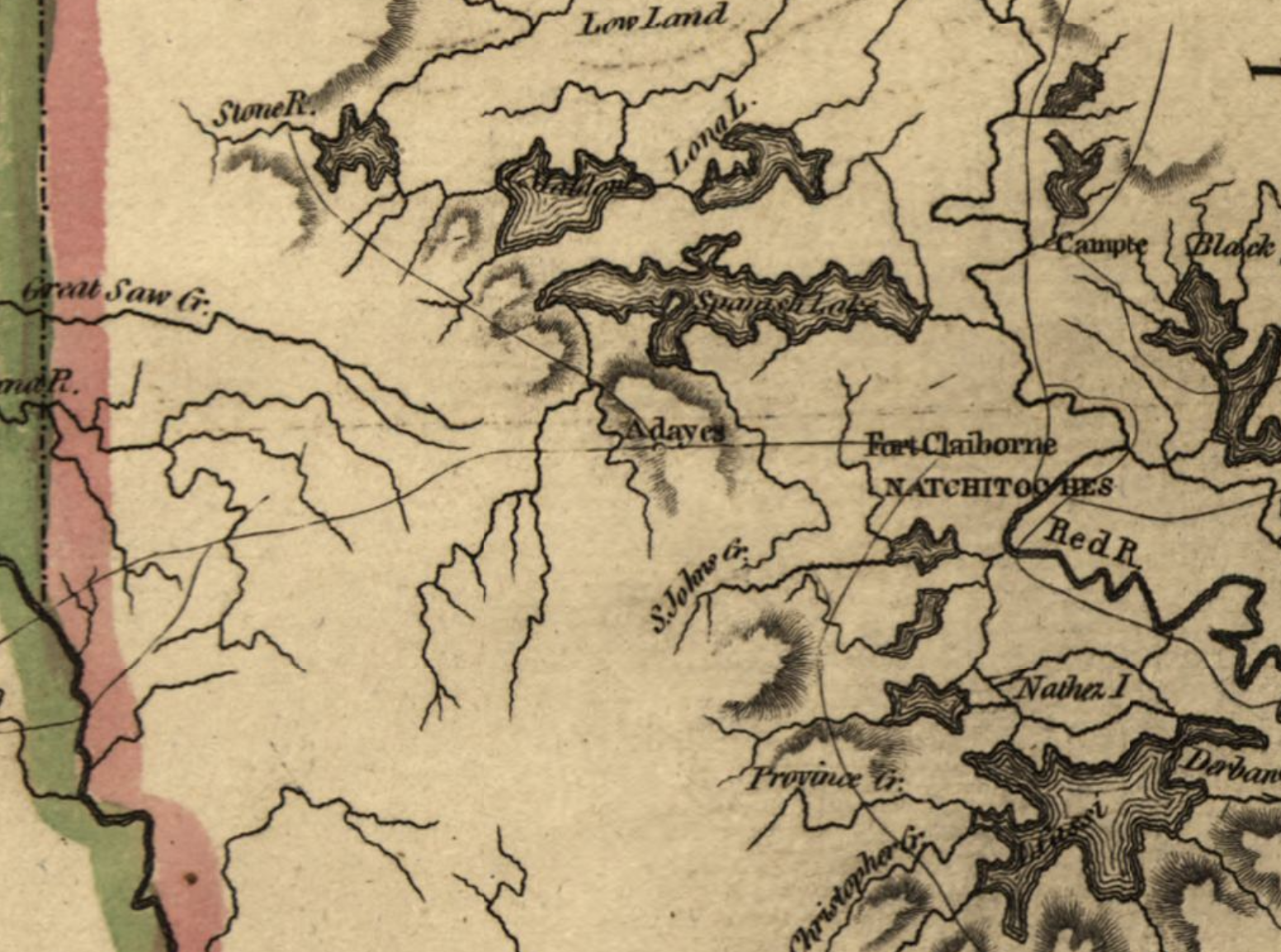
El Camino Real
The villages of the Adai at that time extended from the Red River southward beyond the Sabine into Texas, and the latter stream was known in the 18th century as Rio de los Adais.
The trail between some of their villages became part of the road between Natchitoches and San Antonio, known variously as the Contraband Trail, San Antonio Trace, and El Camino Real, which passed through Los Adaes.
Dr. Clarence H. Webb
"The Belcher Mound, A Stratified Caddoan Site in Caddo Parish, Louisiana," Society for American Archaeology, 1959
The Adais came to settle along this buffalo trail (El Camino Real) near Spanish Lake. El Campti originated the meeting place on the great sandbar near Campti Louisiana, so that each fall all tribes of the Caddo Confederacy could come and trade.
De Vaca writes in the year 1530 that 'we were among the Adais' seeking directions. They were the first white men to travel westward over the buffalo trail.
Louis Raphael Nardini
No Man's Land: A History of the El Camino Real, 1961
The Sabine was suggested as a proper line between the powers, acceptable to France; Spain, however, refused to surrender all claim to the valuable lands adjoining, and east of that river, losing no time in establishing Mission San Miguel de Adaes, in the midst of that powerful woodland tribe, at a point northerly of, and not distant from the present railway crossing at Orange.
The Adaes roamed over, and dominated all that portion of Louisiana, now traversed by Southern Pacific Company, from Lake Charles to Sabine River.
Longfellow refers to the Mission and the tribe, in line. 'Unto the town of Adayes to trade for mules with the Spaniards.' Here, from Acadia and the Adaes Mission, came Evangeline, threading her difficult way in fading footsteps of one who was of more worth to her than all else ' twixt Earth and Heaven.
The Adaes roamed over, and dominated all that portion of Louisiana, now traversed by Southern Pacific Company, from Lake Charles to Sabine River.
Longfellow refers to the Mission and the tribe, in line. 'Unto the town of Adayes to trade for mules with the Spaniards.' Here, from Acadia and the Adaes Mission, came Evangeline, threading her difficult way in fading footsteps of one who was of more worth to her than all else ' twixt Earth and Heaven.
E. H. Woodman
El Nuevo Camino Real, 1898